

Fire Mark Plaques
When inspecting older buildings, particularly Georgian and early Victorian houses, you may notice a small metal plaque fixed high on a façade. Often weathered and easily overlooked, these objects are far more than decorative curiosities. They are fire mark plaques (fire insurance plaques) — physical evidence of an early and very practical form of property insurance.
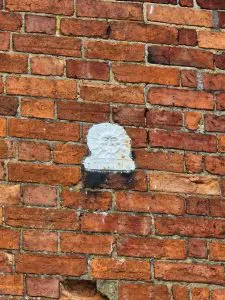
Long before public fire brigades existed, fire protection in Britain was a private, commercial service.
Insurance before public fire brigades
In the late seventeenth and eighteenth centuries, devastating urban fires were a constant risk. Following the Great Fire of London in 1666, the concept of insuring buildings against fire began to take hold. Early insurers did not simply pay out after a loss; they actively sought to prevent it.
Fire insurance companies established and maintained their own engines, equipment, and crews. In return for an annual premium, a property owner received insurance cover and a plaque, known historically as a fire mark, fixed to the exterior of the building. The plaque served as an unmistakable signal: this property was insured, and therefore entitled to assistance.
Among the best-known early offices were the Sun Fire Office, the Hand in Hand Fire Office, and the Phoenix Fire Office. Each had its own distinctive emblem, allowing crews to identify “their” buildings quickly in the event of a blaze.
Why fire marks were mounted high on façades
From a surveying perspective, the position of these plaques is a clue to their purpose. Fire marks were commonly installed high and prominently, so they remained visible from the street above shopfronts, signage, hoardings, and later alterations. Their job was not to be admired at close quarters, but to be recognised quickly in an emergency.
A selective and competitive response to fire
The system, by modern standards, was deeply flawed. If a building caught fire and did not display a recognised plaque, a private fire brigade might stand by. Worse still, if the property was insured with a rival office, assistance could be refused altogether, unless there was a risk of the fire spreading to insured neighbours.
This competitive arrangement sometimes led to multiple brigades arriving at a fire, each concerned only with properties bearing their own mark. Unsurprisingly, this could result in delays, arguments, and avoidable losses, particularly in dense urban areas.
Sun Fire Office plaques and the link to modern insurers
The Sun Fire Office, founded in 1710, is especially significant. Its fire marks, often featuring a radiant sun motif, are among the more commonly encountered examples today. The company expanded steadily, evolving into the Sun Insurance Office and, through later mergers, becoming part of Sun Alliance in the twentieth century.
That lineage continued with the formation of Royal & Sun Alliance, meaning that a modest fire mark on a Georgian townhouse can be connected to one of today’s major international insurers. Few corporate histories are so visibly embedded in the built environment.
Decline of the private system
By the early nineteenth century, the limitations of privately funded fire brigades were increasingly apparent. Large fires demonstrated the need for coordinated, city-wide response rather than selective protection. Gradually, insurers withdrew from active firefighting, and responsibility shifted to public authorities.
In London, this process culminated in the establishment of the London Fire Brigade, marking the effective end of insurance-based firefighting.
Common fire marks and how to recognise them
If you have spotted a fire mark on your home, the insurer can sometimes be identified by the emblem cast into the plaque. Even where the surface has been overpainted, the stronger motifs often remain partially visible as raised outlines.
Sun Fire Office
Often shows a bold radiant sun motif in relief. Even when painted over, traces of rays (and sometimes a central face) are usually still discernible. If your plaque has a circular form with radiating lines, Sun is a common candidate.

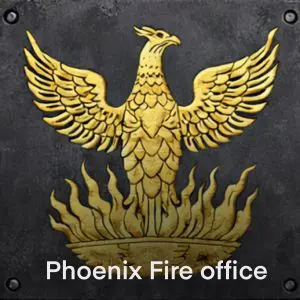
Phoenix Fire Office
Typically depicts a phoenix with outstretched wings, often with flames or a stylised base beneath. This is generally quite distinctive and tends to remain readable even under later paint layers. If you can make out a bird-like outline, Phoenix is worth considering.
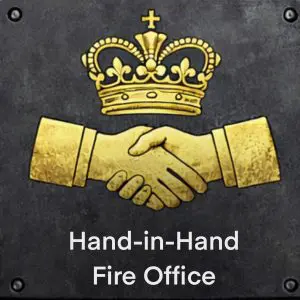
Hand in Hand Fire Office
Usually features clasped hands or a shield-like emblem. These marks are also fairly distinctive and may still show as a recognisable shape even where details have been softened by age and paint.
Why fire mark plaques still matter today
Today, fire insurance plaques have no functional purpose, but they remain historically and architecturally significant. They provide insight into early approaches to risk, insurance, and urban management, and they contribute to the narrative of a building’s past use and status.
From a conservation standpoint, surviving plaques are generally regarded as fixtures of historic interest. Their removal from listed buildings or buildings within conservation areas would typically require careful justification and, in many cases, consent.
For surveyors and estate agents, these plaques offer more than visual interest. They are small but telling reminders that the history of property ownership, insurance, and risk management is quite literally written into the fabric of many of the buildings we work with every day.
Need Help Selling or Buying a Period Home?
If you are considering the sale or purchase of an older home, we can help. David Cosby Chartered Surveyors and Estate Agents provide a professional sales and surveying service across Northamptonshire and the surrounding areas, combining building expertise with a client-focused approach. Please feel free to contact us to discuss your plans.